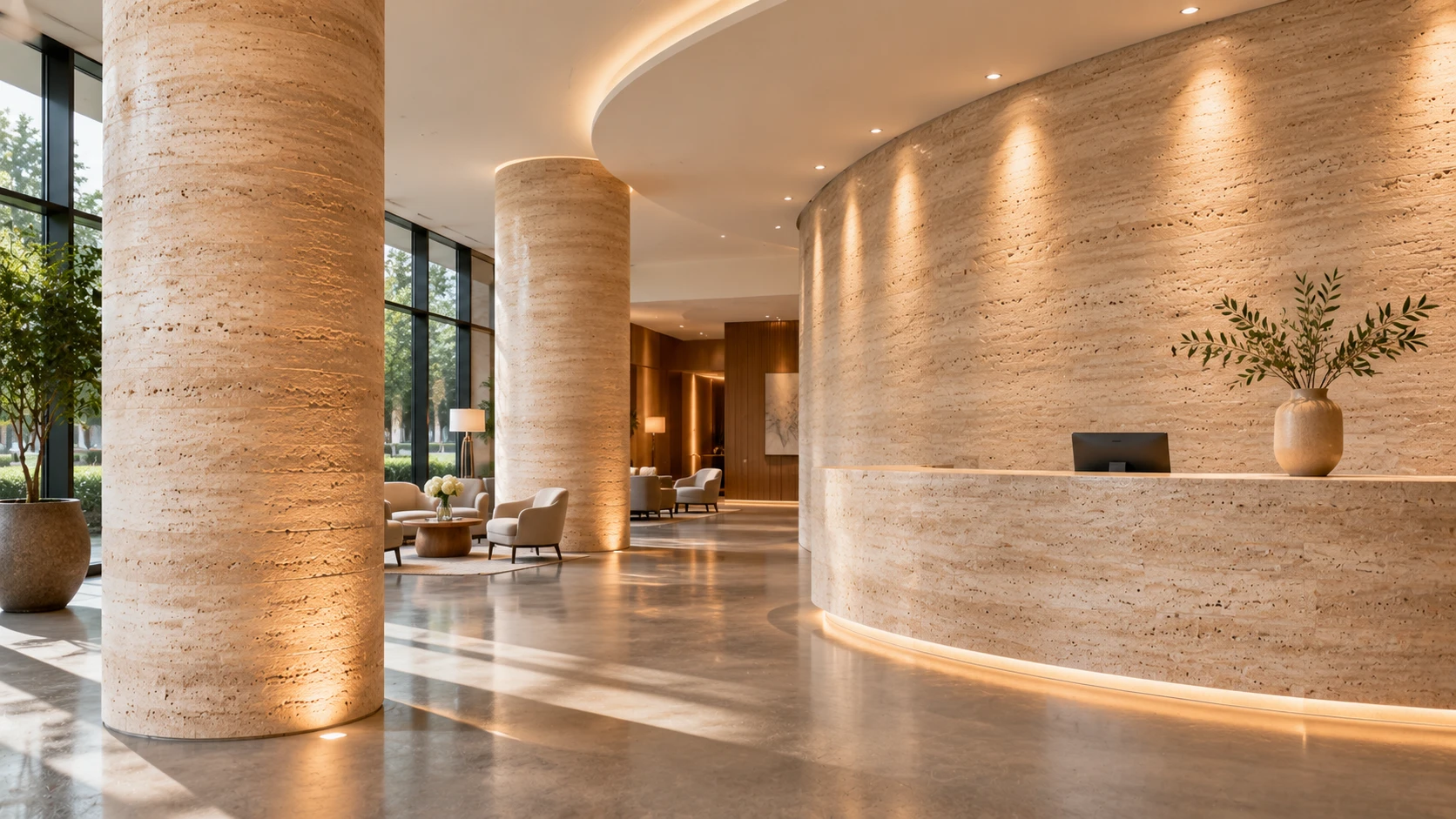
Cladding a curved wall or a round column with stone or tile is hard because rigid materials cannot bend. They have to be cut into narrow strips that turn the curve into a series of flat facets. Flexible cladding, such as Modified Clay Material (MCM) panels or flexible stone veneer, bends to follow the curve in larger pieces. This guide covers where curves are used, what goes wrong with rigid finishes, and how to plan a curved surface that looks continuous.
Why curves are everywhere in 2026 interiors
Rounded walls, arched openings, pill-shaped niches and curved reception desks have replaced many hard edges in homes and commercial spaces. Curves soften a room, guide people through a lobby or store, and make a space feel more welcoming. They also make finishing harder, because most wall materials were designed for flat surfaces.
Common curved surfaces that need cladding
Round and oval columns in lobbies, restaurants and retail stores
Curved feature walls and rounded room corners
Reception desks, bar fronts and service counters
Arched doorways, niches and window reveals
Curved staircases and balustrade walls
Rounded exterior corners, canopies and facade details
What goes wrong with rigid stone and tile on curves
Faceting. Narrow flat strips create a polygon instead of a smooth curve, which is visible in raking light.
More joints. Each strip adds a joint, so a column can end up with more grout lines than stone.
Waste and labour. Cutting many small pieces takes time and produces offcuts.
Pattern breaks. Veining and texture are interrupted at every cut, so the surface loses the look of one continuous material.
Weight. Heavy stone on a column or a curved stud wall adds load that the structure has to carry.
Flexible options for curved surfaces
Flexible natural stone veneer
A very thin layer of real stone on a flexible backing. It can bend around curves and keeps the authenticity of stone. Bend limits, sizes and textures depend on the stone type and the product.
MCM (Modified Clay Material) panels
MCM is a thin, lightweight, mineral-based panel that reproduces stone, travertine, marble, wood, brick, rattan and woven textures. PHOMI, which invented the econiclay® technology used to make it, states that its MCM "adapts to curved and complex architectural surfaces." Because the same material comes in many textures, a project can use one system for flat walls and curves. For background, see What Is MCM Flexible Stone?
How to plan a curved surface that looks continuous
Confirm the bend radius
Every flexible product has a minimum radius it can follow. Measure the tightest curve in your design, such as a small column, and ask the supplier to confirm that the specific product and thickness can follow it.
Choose the texture direction
Linear textures such as travertine layers, ridged stone or wood grain can run around a column or up it. Horizontal layers wrapping a column emphasise its roundness; vertical grain makes it look taller.
Plan the joints
On a column, place the vertical joint where it is least visible, such as facing a wall or behind a planter. On long curved walls, large panels reduce the number of joints.
Detail the edges
Decide how the cladding meets the floor, the ceiling, door frames and flat walls. Clean edges and consistent reveals make a curved surface look intentional.
Prepare the substrate
The curve itself must be smooth and true. A wavy substrate shows through any thin finish. Follow the manufacturer's substrate and adhesive requirements.
Light it well
Grazing light from above or below brings out texture on curves. It also exposes uneven surfaces, so check the substrate under the final lighting before installation.
Using curves in commercial projects
Architects and designers often use curved stone-look surfaces to anchor a lobby, guide circulation in a store, or wrap structural columns that would otherwise look utilitarian. For commercial work, collect the documents early: fire test reports for the specific product, installation instructions and any requirements from the local building authority. PHOMI Canada publishes its fire testing documents and MCM test report on its certificates page.
Quick answers
How do you clad a round column with stone? Either cut rigid stone into narrow strips, which creates facets and many joints, or use a flexible stone-look panel that bends around the column in larger pieces.
What is the best material for curved walls? Flexible materials such as MCM panels or flexible stone veneer, chosen to suit the tightest radius in your design.
Can MCM bend around small columns? MCM is flexible, but every product has a minimum radius. Confirm it with the supplier for your column size.