Travertine Walls Trend 2026: Get the Look Without Heavy Stone | PHOMI | Phomi Canada
PHOMI journal
Travertine Walls Are Back: How to Get the Look Without Heavy Stone
Travertine is one of the strongest wall trends of 2026. See where travertine walls work best, the limits of heavy stone, and how to get the travertine look on any wall.
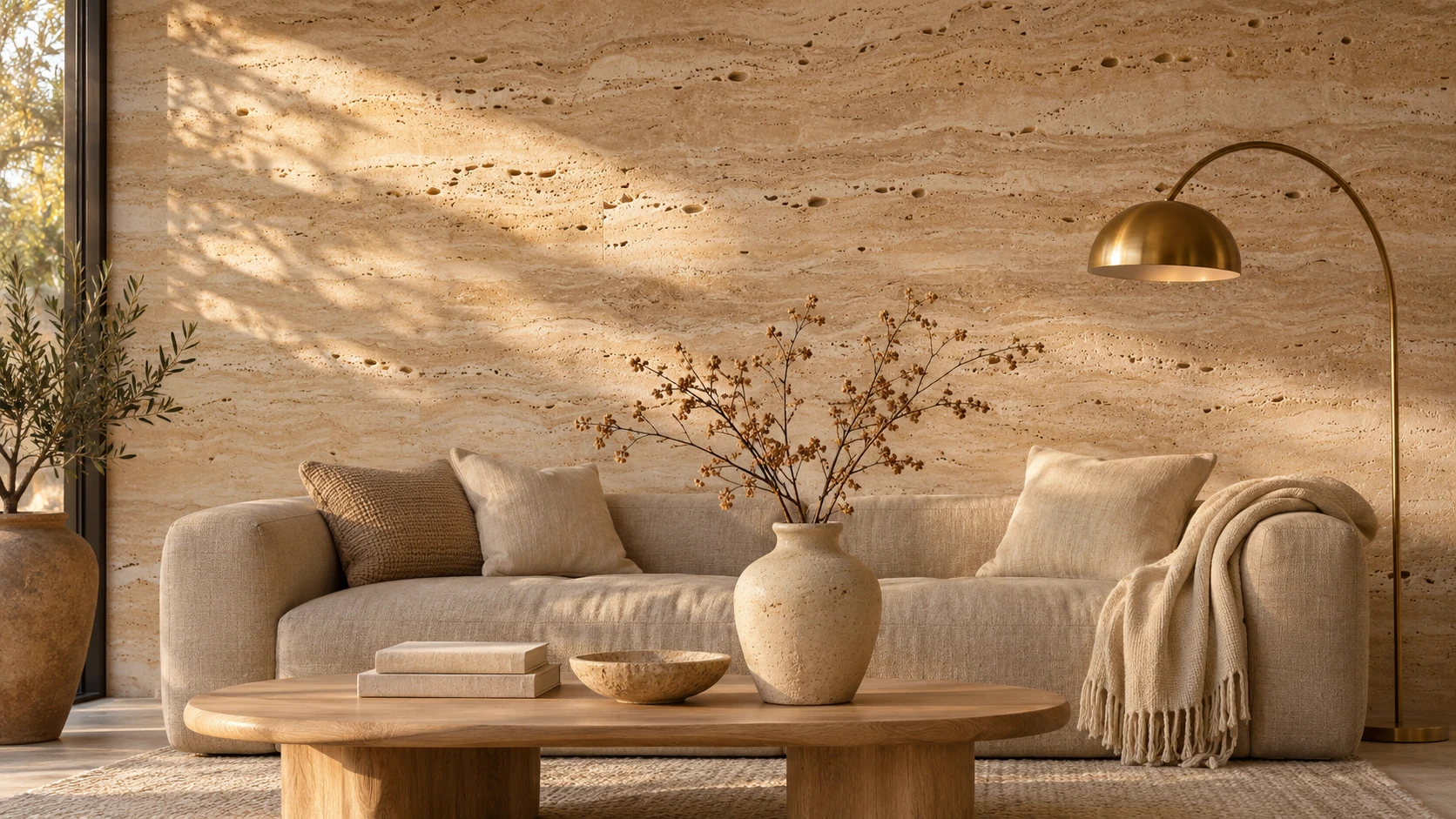
Travertine is back on interior walls. Designers are using its warm colour, soft pores and layered veining on feature walls, fireplaces, bathrooms and kitchens, often as a calmer alternative to polished marble. The look is easy to love, but full-thickness travertine is heavy, porous and slow to install. This guide covers where the trend is going in 2026 and how to get the look on walls that were never built to carry stone.
Why travertine is trending again
Travertine has been used in buildings for thousands of years, and it has had several revivals since. Design publications such as Livingetc have tracked its return, and Apartment Therapy reports that designers now prefer stone with visible character and patina over perfectly uniform surfaces.
Three things explain the appeal:
Warmth. Creams, honeys, rusts and soft greys sit well with the earthy palettes that have replaced all-white interiors.
Texture. The open pores and horizontal layers catch light, so a travertine wall looks different in the morning and at night.
Restraint. Travertine reads as natural and quiet, where heavily veined marble can dominate a room.
Where travertine walls work best
Living room feature walls
One full-height travertine wall behind a sofa or media unit adds depth without adding clutter. Large panels with few joints keep the surface calm.
Fireplace walls
A travertine-look surround or full fireplace wall is one of the most requested versions of the trend. See our stone fireplace wall ideas for layouts and the safety questions to ask first.
Bathrooms
Travertine-clad bathrooms have a spa feel, especially in warm tones. Check that the finish you choose is suitable for wet areas before you plan it inside a shower.
Kitchens and dining areas
A travertine-look backsplash or dining wall pairs well with wood, plaster and matte metals.
Commercial interiors
Hotel lobbies, restaurants, clinics and retail stores use travertine to feel warm and established without looking ornate.
The problem with full-thickness travertine on walls
Quarried travertine slabs and tiles are beautiful, but they come with practical limits:
Weight. Natural stone veneer is heavy, and installers usually need cement backer board or masonry behind it. Stone World advises against installing natural stone veneer over drywall.
Porosity. The open pores that give travertine its texture can trap dirt and moisture unless the stone is filled and sealed.
Curves. Rigid stone cannot wrap a rounded wall or column without cutting it into many small pieces.
Time on site. Mortar beds, cutting and sealing add days to an installation.
For many walls, the goal is the travertine look rather than the stone itself.
How to get the travertine look on any wall
Travertine-look finishes made from Modified Clay Material (MCM) reproduce the pores, layers and colour of travertine in a thin, flexible panel. If MCM is new to you, start with What Is MCM Flexible Stone?
PHOMI Canada's travertine family has 41 finishes across six series: Rome Travertine, Coral Travertine, Cloud Silk Travertine, Oceanic Travertine, Greece Travertine and Granite Flat. Colours range from Andes White and Cloud White to Kamu Red, Stratus Dark Grey and Ink Cloud Grey, so the same look can be soft and light or deep and moody.
Because the panels are light and flexible, they can go on flat walls, rounded walls and columns. Large formats mean fewer joints, which matters with travertine, since the eye follows the horizontal layers across the wall. For smaller home projects, PHOMI's DIY eCovering includes Rome Travertine finishes with a self-adhesive backing for walls.
Travertine-look MCM is not quarried travertine, and we describe it as travertine-inspired. If your project calls for genuine stone, choose stone.
How to choose a travertine colour
North-facing rooms in Canada get cool light for much of the year. Warm creams and honeys keep them from feeling grey.
South-facing rooms can carry cooler greys and whites without feeling cold.
Small rooms benefit from light tones and large panels, which make the wall read as one surface.
Dramatic spaces such as bars, restaurants and powder rooms can take rust, red or dark grey tones.
Always look at a physical sample on the wall in question, at different times of day, before you decide.
Pairings that suit the 2026 travertine look
Light oak or walnut furniture and millwork
Limewash or plaster walls in the same colour family
Brushed brass, bronze or blackened steel fixtures
Linen, boucle and wool textiles
Warm white lighting, around 2700K to 3000K, to bring out the texture
Quick answers
Is travertine still in style in 2026? Yes. Designers are using it for walls, fireplaces and bathrooms, with more emphasis on texture and natural variation.
Can travertine go on a drywall wall? Full-thickness natural travertine usually needs a stronger substrate such as cement backer board. Lightweight travertine-look panels can go on walls where stone would be impractical; follow the manufacturer's substrate requirements.
Can I get a travertine look on a curved wall? Yes, with a flexible travertine-look panel. Rigid stone would need to be cut into small pieces.